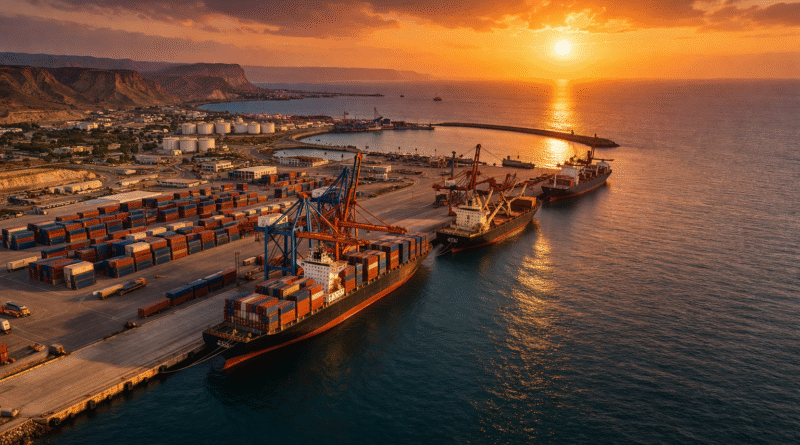
Chabahar Port: India’s $370 Million Bet in Iran Is Now on the Line
Chabahar port India 2026 — these four words represent one of the most consequential foreign policy dilemmas India has faced in years. On April 26, 2026, a US sanctions waiver that has allowed India to continue operating the Shahid Beheshti terminal at Iran’s Chabahar port expires. What India does next will define not just its relationship with Iran — but its strategic autonomy, its Central Asia ambitions, and its willingness to stand firm when Washington applies pressure.
The story of how India got here is a decade long — and it is not a story of strategic failure. It is a story of a bold, visionary project being squeezed between two great powers: the United States, which wants Iran isolated, and Iran itself, which is now at war with the US and Israel. India built something genuinely important at Chabahar. The question is whether it will be allowed to keep it.
What Is Chabahar Port and Why Does India Care?
Chabahar is located on Iran’s southeastern coast on the Gulf of Oman — crucially, outside the Strait of Hormuz. That single geographic fact is what makes it strategically priceless for India. Every other port in the Persian Gulf is inside the Hormuz chokepoint that Iran has now effectively closed. Chabahar is not.
India’s interest in Chabahar goes back to 2003, when the two countries signed a bilateral agreement to develop the port. The breakthrough came in May 2016 when India, Iran, and Afghanistan signed the Trilateral Transit and Trade Agreement — giving India rights to develop and operate two berths at the Shahid Beheshti Terminal.
The strategic logic was compelling. Chabahar gives India direct access to Afghanistan and Central Asia without having to cross through Pakistan — a country that has consistently blocked India’s land connectivity to the region. It is also a key node in the International North-South Transport Corridor — a 7,200 km trade route connecting India with Russia and Europe via Iran, Azerbaijan and the Caspian Sea. And it sits directly across from China’s Gwadar port in Pakistan — giving India a strategic counterbalance to Beijing’s growing Indian Ocean presence.
In May 2024, India Ports Global Limited signed a ten-year lease to equip and operate the port, committing $120 million in investment and pledging an additional $250 million credit line. That is $370 million of Indian strategic capital — built over a decade of patient diplomacy.
How the Sanctions Trap Was Set
The trouble began in February 2025 when the Trump administration signalled its intention to put Chabahar back under US sanctions as part of its maximum pressure campaign against Iran. The original sanctions waiver — granted in 2018 under Secretary of State Mike Pompeo — had recognised Chabahar’s role in supporting Afghanistan’s development and the US-India strategic partnership.
On September 29, 2025, the US revoked that waiver. The decision was immediate and brutal in its implications. Any entity operating Chabahar or providing significant support to Iranian entities could now face sanctions under the Iran Freedom and Counter-Proliferation Act. Indian individuals and corporate entities connected to Chabahar operations risked exposure that could affect their access to US markets and financial systems.
The response within India Ports Global Limited was telling. Government directors on IPGL’s board resigned en masse. The company’s website was taken down — to insulate everybody associated with the port from potential sanctions, according to sources. India had built a decade-long strategic asset, and overnight it had become a liability.
India then made a move that revealed the depth of the dilemma. According to reporting by ET Infra, India transferred the entirety of its $120 million financial commitment to Iran before the sanctions kicked in — effectively liquidating its direct liabilities. P Manoj, Editor of ET Infra, noted: the timing of the payment was what struck him most. India paid in full before sanctions took effect, then informed OFAC that it intended to wind down all activities at the port. Based on this, OFAC granted the six-month conditional waiver — valid from October 29, 2025 to April 26, 2026.
Full Timeline
| Date | What Happened |
| 2003 | India and Iran sign bilateral agreement to develop Chabahar |
| May 2016 | India, Iran, Afghanistan sign Trilateral Transit Agreement |
| 2018 | IPGL takes over port operations; US grants first sanctions waiver |
| May 2024 | India signs 10-year lease; commits $120 million + $250 million credit line |
| February 2025 | Trump signals intention to revoke Chabahar waiver |
| September 29, 2025 | US revokes sanctions waiver — IPGL directors resign en masse |
| October 29, 2025 | India receives 6-month conditional waiver valid to April 26, 2026 |
| January 2026 | Reports emerge India may be winding down; India transfers full $120 million to Iran |
| February 28, 2026 | US-Israel strike Iran — Chabahar situation becomes critical |
| April 26, 2026 | Waiver expires — India must secure extension or exit |
What the April 26 Deadline Actually Means
The waiver expires on April 26, 2026 — just 35 days from today. Under the terms of the waiver, any future extension would need the US Secretary of State to justify to Congress that it is vital to US national security. In the current climate — with the US and Israel actively at war with Iran — that justification would be politically difficult for any US administration to make.
India’s Ministry of External Affairs has maintained that it remains engaged with Washington on the issue. At its weekly briefing in January, MEA spokesperson Randhir Jaiswal said India is still working out this arrangement with the US. But the diplomatic language itself has been revealing. India has not said it will stay. It has not said it will go. It is in the classic Indian foreign policy position of strategic ambiguity — buying time while the situation develops.
Congress has used the episode to mount a broader critique of the Modi government, alleging that India’s strategic autonomy is being eroded and that policy choices concerning Iran are now effectively being shaped in Washington. Congress leaders have asked whether New Delhi’s Iran policy is being dictated from the White House. The government has rejected this framing — but has not provided a clear answer on what happens after April 26.
The Stakes — What India Loses If It Exits, What It Risks If It Stays
| What India Loses If It Exits | What India Risks If It Stays |
| Gateway to Afghanistan and Central Asia bypassing Pakistan | US secondary sanctions on Indian entities |
| INSTC node connecting India to Russia and Europe (7,200 km route) | 25% tariff threat on all India-US trade |
| Strategic counterbalance to China’s Gwadar port in Pakistan | Exposure under Iran Freedom and Counter-Proliferation Act |
| $370 million in committed investment ($120M + $250M credit) | Indian individuals and firms could lose US market access |
| Decade of diplomatic goodwill with Tehran | Complications for India-US trade deal negotiations |
Is This an Exit or a Tactical Pause?
Analysts are divided. P Manoj of ET Infra, who broke the original story, believes the combination of sanctions and tariff threats left India with little choice but to wind down. The reimposition of sanctions and the latest tariff knock by Trump does not give India any leeway to continue in Chabahar, he said.
But Wadhwa, another analyst quoted by TRT World, sees this differently — as a tactical recalibration rather than a complete withdrawal. The funds were transferred so that work in the Shahid Beheshti terminal does not come to a stop. He noted this kind of balancing act is not new for New Delhi.
India’s MEA has framed the current phase as a test of strategic balancing — requiring cooperation with Washington without sacrificing India’s long-term interests in West and Central Asia. The problem is that this framing requires Washington to cooperate. And Washington’s current posture toward Iran is the most hostile it has been since the 2020 Soleimani assassination.
There is one more dimension that makes Chabahar strategically irreplaceable right now: the Iran war has closed the Strait of Hormuz, making every Gulf port inaccessible. Chabahar — outside Hormuz — is the one port on Iran’s coast that could theoretically still function as a transit hub. India shipping 20,000 tonnes of wheat aid to Afghanistan through Chabahar in 2023 demonstrated what this port can do. Abandoning it now, precisely when its outside-Hormuz location makes it most valuable, would be a strategic blunder of the highest order.
ThirdPol’s Take
Chabahar is not just a port. It is the physical embodiment of India’s claim to be a serious strategic power in its own neighbourhood — one that can build, invest, and maintain presence in difficult geographies despite great power pressure.
India has spent a decade and $370 million building something that no other democracy has managed: a functioning strategic foothold in Iran. The US has sanctions. China has Gwadar. Russia has pipelines. India has Chabahar — or had it, depending on what happens on April 26.
The argument for staying is strong. Chabahar outside Hormuz is more valuable now than it has ever been. The INSTC corridor it anchors connects India to Russia, Central Asia and Europe — a route that becomes more important the more unstable the Gulf becomes. The Taliban in Afghanistan have expressed interest in using Chabahar for trade. The port is not a diplomatic gesture. It is critical infrastructure.
The argument for exiting is also real. The sanctions exposure is genuine. Indian entities risk losing US market access. The trade deal with Washington is at a delicate stage. And the Iran war makes any association with Tehran diplomatically complicated.
But here is the question India must ask itself: if it exits Chabahar under US pressure now — while India is BRICS chair, while it claims to speak for the Global South, while it lectures other nations about strategic autonomy — what does that say about whether India’s strategic autonomy is real or rhetorical?
The April 26 deadline is not just about a port. It is a test of whether India means what it says.
Amit Mangal writes on India’s foreign policy and geopolitics at ThirdPol. Follow ThirdPol on X and LinkedIn.