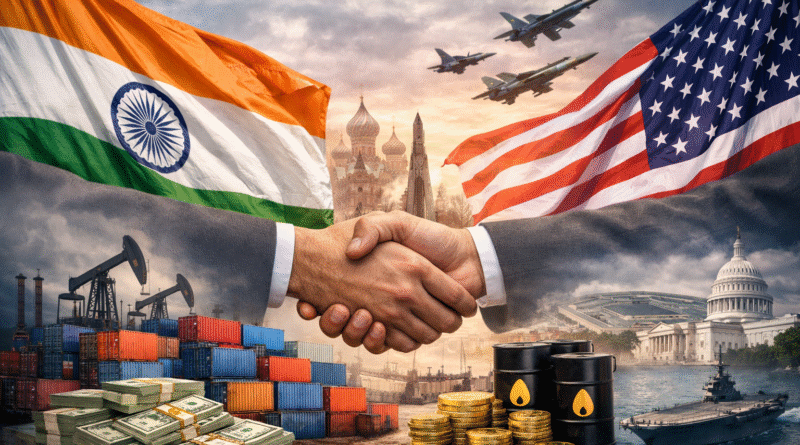
India Tested: From U.S. Sanctions Pressure to a One-Sided Trade Deal?
The proposed India–US Bilateral Trade Agreement has triggered serious debate in political circles and among policy experts. Even though the agreement is not yet final, the discussions around it have already exposed deeper concerns. This is no longer just about tariffs. It is about how India positions itself in a changing global order.
At first glance, the government’s objective is practical and understandable. The United States has imposed high tariffs on several Indian exports. Any deal that reduces this burden can support Indian businesses and boost economic growth. Market access to the world’s largest economy is not a small opportunity.
But trade deals are rarely only about trade. They often carry strategic weight. And in this case, the way negotiations around the India–US Bilateral Trade Agreement have unfolded raises uncomfortable questions.
A Negotiation Between Equals?
One striking feature of the proposed India–US Bilateral Trade Agreement is the communication pattern. Most major announcements have come from Washington, not New Delhi. Initial signals of progress were shared publicly by the U.S. President, followed by executive actions and official briefings in the United States.
India’s responses appeared measured and limited. There was no equally strong public articulation from the Indian side.
This matters. In diplomacy, perception is powerful. When information flows mainly from one side, it creates an impression that one party is setting the pace while the other is adjusting. A genuine partnership should look balanced, especially between two major democracies.
If tariff relief under the India–US Bilateral Trade Agreement comes with quiet policy adjustments behind the scenes, the public deserves clarity.
Energy Security: Economics or Politics?
India’s energy policy has been guided by one central concern: affordability. After global oil markets were disrupted, India significantly increased purchases of discounted Russian crude. At one stage, Russia accounted for roughly 40 percent of India’s oil imports. That decision was defended as purely economic. The priority was protecting Indian consumers from rising fuel prices.
Recently, however, reports suggest a decline in Russian oil imports despite attractive discounts.
This shift raises an obvious question. Is the change driven by market logic or geopolitical pressure linked to the broader negotiations around the India–US Bilateral Trade Agreement?
If cheaper energy is available but not used, it means economic calculation is giving way to political considerations. That may be necessary in some cases. But such decisions should be openly acknowledged, not quietly absorbed into trade talks.
Energy security is not an abstract policy issue. It affects inflation, industry, and household budgets. For a developing economy, every dollar saved on imports matters.
Diplomatic Ripples Beyond Washington
Foreign policy does not operate in isolation. The direction of the India–US Bilateral Trade Agreement may influence India’s broader diplomatic relationships.
Countries like Russia and Iran have long viewed India as an independent actor. India resisted unilateral sanctions that were not endorsed by global institutions. That stance strengthened its image across the Global South as a country that made decisions based on national interest, not external pressure.
If India is seen aligning too closely with U.S. expectations as part of the India–US Bilateral Trade Agreement, that perception could change. Trust once shaken is not easily rebuilt.
There is also the question of other trade partners. India has ongoing negotiations and agreements with the European Union and several Asian economies. Preferential treatment toward one country may complicate future talks. Trade diplomacy requires careful balance.
Regional Strategy and Geopolitics
The proposed India–US Bilateral Trade Agreement may also have unintended regional consequences.
Take the example of Chabahar port in Iran. The project holds strategic value for India’s connectivity to Central Asia and Afghanistan. Reduced engagement with Iran could create space for China to expand its influence in the region.
Trade concessions today may influence geopolitical alignments tomorrow. That is why the debate around the India–US Bilateral Trade Agreement cannot remain limited to tariff percentages.
If economic cooperation becomes linked with expectations in defence, Indo-Pacific strategy, or security partnerships, the character of the India–U.S. relationship could change in a lasting way.
Strategic Autonomy Under Strain
Since independence, India has followed a principle of strategic autonomy. It built relations with multiple global powers while avoiding formal alignment with any single bloc. This approach gave India flexibility. It allowed cooperation with the United States, Russia, Europe, and developing nations at the same time.
In 2019, India walked away from the Regional Comprehensive Economic Partnership due to concerns about economic dependence and policy constraints.
If India now accepts stronger external conditions under the India–US Bilateral Trade Agreement in exchange for tariff relief, critics will inevitably point to that earlier decision. Consistency matters in foreign policy. Nations are judged not only by what they gain, but by how they gain it.
The risk is subtle but real. Instead of expanding room for manoeuvre in a multipolar world, India could gradually narrow its options.
Economic Gains vs Sovereign Space
To be clear, closer trade ties through the India–US Bilateral Trade Agreement can benefit India. Lower tariffs can help exporters. Greater integration with global supply chains can create jobs. Investment flows may increase.
But the core issue is not whether India should trade more with the United States. It absolutely should. The question is whether economic gains come with expectations that reshape independent decision making.
Every major power negotiates hard. That is the nature of global politics. The challenge for India is to ensure that short term tariff relief under the India–US Bilateral Trade Agreement does not quietly erode long standing principles.
This moment feels like a test. Not of loyalty, but of balance.
If India can secure economic advantages while preserving strategic autonomy, the India–US Bilateral Trade Agreement will be seen as a mature partnership. If not, it may mark a shift from multi alignment to subtle dependence.
The debate, therefore, is bigger than trade. It is about how India chooses to engage with the world, and on what terms.
Pingback: India–US Trade Deal 2026: What India Gave Up, What It Got, and Why It Is Now on Hold