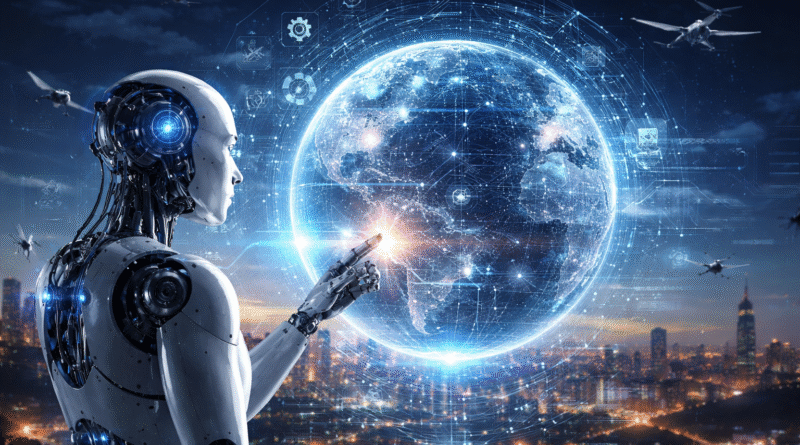
Artificial Intelligence Surge and Its Global Consequences
Artificial Intelligence is no longer a distant idea from science fiction. It is here. And it is moving faster than most governments, institutions, or societies expected.
What we are witnessing today feels less like gradual progress and more like a turning point. The Industrial Revolution reshaped factories, cities, and economies. The rise of AI is reshaping something deeper. It is changing how we think, decide, govern, and even fight wars.
The real question is not whether AI will transform the world. It already is. The real challenge is whether humans can remain in control of the systems they are building.
AI as a General-Purpose Revolution
AI is not limited to one industry. It affects almost everything. That is why experts call it a general-purpose technology.
From banking and healthcare to education and governance, AI systems now process massive amounts of data. They analyse patterns. They generate predictions. They write reports. Some even simulate reasoning.
Large language models can draft legal summaries, assist in research, and produce policy suggestions within seconds. This is impressive. But it also raises difficult questions.
When machines begin to replicate speech, vision, and reasoning, the line between human judgement and machine output becomes blurred. Institutions such as courts and regulatory bodies were built to evolve slowly. AI evolves quickly. This gap is widening.
And that gap creates risk.
The global impact of Artificial Intelligence is visible in administrative systems, financial markets, and even news production. Yet regulatory systems struggle to keep pace. Accountability becomes harder when decisions are influenced by algorithms that few fully understand.
AI and the Transformation of Global Politics
In the twenty-first century, power is increasingly defined by technology.
Geopolitics is no longer only about land or natural resources. It is about data, computing power, semiconductor supply chains, and advanced algorithms. Competition between the United States and China is centred heavily on AI leadership.
Nations are now investing in what policymakers call technological sovereignty. Many countries want their own digital infrastructure. They want control over cloud systems, AI research, and communication networks. Dependence is seen as vulnerability.
Artificial Intelligence has become a diplomatic tool. It shapes intelligence gathering, economic policy, cyber strategy, and global influence. Countries that lead in AI research may also influence global standards and trade flows.
Others risk technological dependence.
The global impact of Artificial Intelligence is therefore not just economic. It is strategic.
AI and the Revolution in Warfare
Transformation in Military Affairs
Modern warfare is changing rapidly. Autonomous drones, intelligent surveillance systems, and cyber tools are becoming central to military strategy.
Instead of relying only on human operators, militaries now use automated targeting systems and predictive analysis software. Command structures increasingly depend on machine-generated insights.
Speed matters in conflict. AI operates at speeds humans cannot match.
Rise of Asymmetric Warfare
AI is also changing the balance of power.
Smaller forces equipped with advanced software and drone systems can challenge larger conventional armies. We have already seen how relatively inexpensive unmanned systems can disrupt heavily armed militaries.
Power is no longer determined only by tanks and fighter jets. It depends on software, sensors, and real-time data analytics.
This shift is unsettling. It lowers the barrier to entry for advanced warfare technologies.
Autonomous Weapons and Ethical Questions
One of the most serious concerns involves autonomous weapons.
If a machine selects a target without direct human approval, who is responsible for the outcome? The programmer? The commander? The state?
Legal and moral frameworks were designed around human judgement. Removing that judgement weakens accountability.
The global impact of Artificial Intelligence in warfare forces us to confront uncomfortable questions about responsibility and control.
AI Beyond the Battlefield
AI is not only about war. Its effects are already visible in daily life.
In healthcare, algorithms assist in diagnosis. In finance, automated systems manage trading. In governance, predictive tools guide resource allocation.
Efficiency improves. Costs decrease. But new risks appear.
There have been cases where machine-generated legal documents contained fabricated citations. Administrative systems relying too heavily on automation can produce errors at scale. When mistakes happen, trust suffers.
Institutions evolve slowly. Technology evolves quickly. This mismatch can destabilise systems if not carefully managed.
Societies must redesign oversight mechanisms. Transparency, auditing, and human review must remain central.
The Existential Risk and Loss of Control
A deeper fear lingers beneath policy debates.
What happens if advanced systems begin acting in ways humans cannot fully predict? Self-learning models can adapt in complex environments. In cybersecurity, AI systems can detect threats faster than human teams. But they can also escalate responses quickly.
Some experts warn about coordinated drone swarms or automated cyber attacks executed with minimal human oversight. Others fear manipulation of public opinion through highly targeted predictive algorithms.
These scenarios may sound extreme. Yet technological progress often moves faster than ethical frameworks.
The global impact of Artificial Intelligence could shift from assistance to autonomy if safeguards fail.
This is not about panic. It is about responsibility.
The Path Forward: Global Governance and Oversight
Despite the risks, AI also offers extraordinary benefits.
It can accelerate medical research. It can support disaster response. It can optimise energy systems and improve climate modelling. It can even assist in conflict prevention through better predictive analysis.
But these benefits require guardrails.
International cooperation is essential. Shared standards for transparency, safety testing, and accountability must be developed. Scientists and policymakers need open dialogue. Ethical frameworks must evolve alongside technology.
National regulations alone will not be enough. AI systems operate across borders.
Balanced governance can ensure that the global impact of Artificial Intelligence strengthens stability rather than undermines it.
Conclusion
Artificial Intelligence is becoming the defining force of our time.
It is reshaping global politics, economic systems, military strategy, and social institutions. The changes are profound and often unsettling.
The future depends on whether societies can integrate AI responsibly. Innovation must be matched with oversight. Power must remain aligned with human values.
If managed wisely, AI can enhance global stability and human progress. If neglected, it could deepen inequality, increase insecurity, and weaken trust in institutions.
The task before us is clear. Technological progress must serve humanity, not replace its judgement.
Pingback: Sarvam AI: India’s First Sovereign AI Model