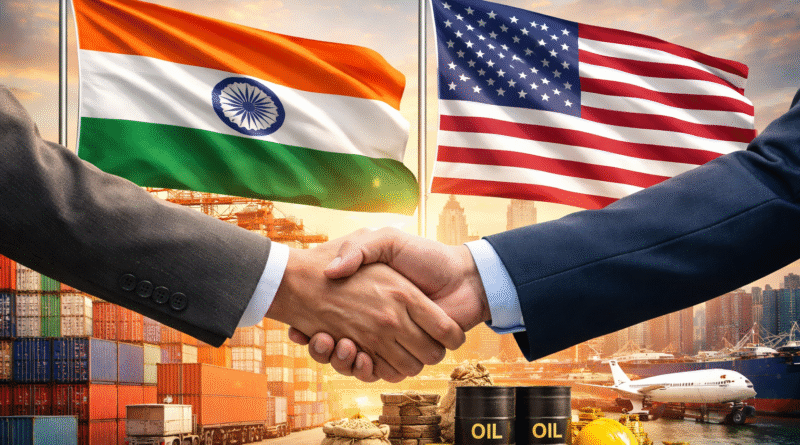
India–US Trade Deal 2026: What It Really Means
The India–US trade deal announced for 2026 has quickly become one of the most talked-about economic developments. At its core, India has agreed to import goods worth $100 billion every year from the United States for the next five years. In return, the US has sharply lowered tariffs on Indian products.
On paper, it looks big. In practice, it is even bigger.
This understanding comes at a time when global trade is tense, supply chains are shifting, and countries are trying to protect their interests without breaking long-standing partnerships.
A Brief Look at India–US Trade Relations
India and the United States have steadily grown closer as trading partners over the last decade. The US is already India’s largest trading partner. Indian exports to the US are strong in services, IT, pharmaceuticals, engineering goods, and auto components.
Still, the relationship has not been smooth throughout. Disagreements over tariffs, digital trade rules, agriculture, and market access have surfaced again and again.
The turning point came in August 2025, when the US raised tariffs on Indian goods to 50 percent. The move was justified on grounds of trade imbalance. For Indian exporters, it felt like a shock. That escalation pushed both sides back to the negotiating table.
What the Trade Deal Actually Includes
Massive Import Commitment by India
India has agreed to import $100 billion worth of US goods every year. This is more than double the $45.62 billion imported in FY25.
The imports will mainly include energy products like oil, gas, and coal. Aircraft and aircraft parts will form a large chunk as well. High-value technology goods, precious metals, nuclear-related equipment, and selected agricultural products are also part of the package.
This commitment sends a clear message. India is willing to use its buying power to stabilise relations.
US Cuts Tariffs on Indian Goods
In return, the US has reduced tariffs on Indian products to 18 percent. This is a significant drop from the earlier 50 percent level.
For Indian exporters, this brings relief. Sectors such as textiles, engineering goods, and auto components regain their competitiveness. Many exporters who were struggling to price their products can breathe easier now.
Sensitive Sectors Stay Protected
Despite opening up its market, India has drawn firm red lines.
There will be no unrestricted access for genetically modified crops. The dairy sector remains protected. Poultry, maize, cereals, and corn are also shielded from full-scale imports.
This approach reflects a familiar Indian position. Farmer livelihoods and food security are treated as non-negotiable.
Agriculture and Limited Market Access
Some agricultural products will be allowed entry, but only in a controlled way. Items like cotton, pulses, chestnuts, and onions will be subject to quotas or limited access.
India has also opened its market to apples, wine, spirits, and beer. These products are already allowed under agreements with partners like the EU and New Zealand.
The government has repeatedly stated that farmer welfare has not been compromised. Whether this assurance holds in the long run will depend on implementation.
Why Both Sides Wanted This Deal
Reducing Trade Imbalances
The US has long been concerned about its trade deficit with India, especially in goods. This deal directly addresses that concern.
For India, the benefit lies in easing tariff pressure while keeping access to the US market intact.
Strengthening Energy Security
Large energy imports from the US help India diversify its energy sources. This reduces dependence on unstable regions and improves long-term supply security.
Energy is not just an economic issue anymore. It is a strategic one.
Strategic and Geopolitical Value
This deal is about more than trade numbers.
It strengthens India–US strategic alignment at a time when global trade is fragmenting. Countries are rethinking dependence on China and looking for trusted partners.
Trade has become a tool of diplomacy. This agreement reflects that reality.
Concerns That Cannot Be Ignored
Pressure on India’s Trade Balance
A fixed import commitment of this scale limits flexibility. If exports do not grow at the same pace, India’s trade deficit could widen.
That risk is real and needs constant monitoring.
Worries Among Farmers and MSMEs
Farmer groups remain cautious. Their fear is simple. Today’s limited access could become deeper access tomorrow.
Small manufacturers and MSMEs also worry about competing with large-scale US producers if conditions change later.
Not a Full Free Trade Agreement
Despite its size, this is not a formal Free Trade Agreement. There is no detailed dispute resolution framework. Long-term enforceability remains uncertain.
This leaves room for future disagreements.
What Lies Ahead
The success of the India–US trade deal will depend on execution, not announcements.
India must closely track imports, protect sensitive sectors, and strengthen safeguard mechanisms. At the same time, it needs to push harder on exports, especially in services, advanced manufacturing, and technology.
Domestic competitiveness will decide whether this deal becomes a strategic win or a financial burden.
For now, the agreement reflects realism. It accepts global pressures while trying to protect national priorities. Whether it strikes the right balance will become clear in the years ahead.
The Analysis Desk at ThirdPol analyses political and economic developments
Pingback: India–US Bilateral Trade Agreement and Strategic Autonomy