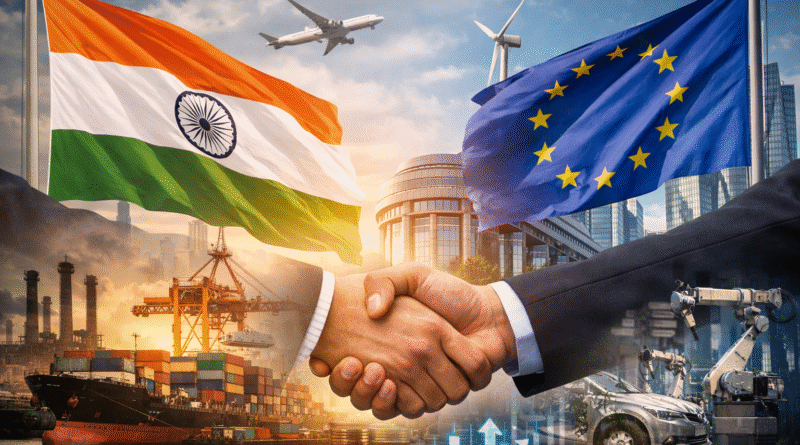
Why Is the India and EU Trade Deal in the News?
India and the European Union have finally concluded negotiations on a long-pending India and EU trade deal, often described as the “Mother of all Deals.” This agreement is being seen as a major economic milestone for India. It is expected to push exports, attract investment, and support India’s long-term goal of becoming a developed nation by 2047 under the Viksit Bharat vision.
The India and EU trade deal comes at a time when global supply chains are shifting and countries are looking for reliable economic partners. For India, this agreement is more than just a trade pact. It is a statement of intent.
Objectives of the India-EU Free Trade Agreement
The India-EU Free Trade Agreement aims to reshape trade relations between the two economies in several key ways.
First, it seeks to reduce or remove tariffs on goods. This will make Indian products more competitive in European markets and improve access for exporters.
Second, the agreement focuses on liberalising services trade. Sectors like IT, digital services, healthcare, and professional services are expected to gain the most.
Another important goal is smoother movement of skilled professionals. Indian talent plays a strong role in Europe’s services sector, and easier mobility will benefit both sides.
The FTA also aims to attract high-quality European investment by ensuring clear rules, transparency, and predictable regulations.
Reducing non-tariff barriers is another priority. Better regulatory cooperation will help Indian exporters meet European standards with fewer hurdles.
The agreement also supports India’s integration into global and European value chains. It positions India as a reliable manufacturing and sourcing hub.
Export-led growth is central to the deal, aligning closely with initiatives like Make in India and the Production Linked Incentive schemes.
Finally, the India and EU trade deal helps India diversify its trade partnerships and reduce dependence on a limited number of markets.
Benefits of the India-EU Free Trade Agreement
Boost to Indian Exports
The European Union is India’s largest export market bloc, accounting for nearly 17 percent of total exports. Reduced or zero tariffs will directly benefit labour-intensive sectors such as textiles, apparel, leather, and footwear. High-value sectors like pharmaceuticals, engineering goods, and chemicals will also gain. In 2024–25, India exported goods worth around USD 75 to 80 billion to the EU.
Growth in Services Trade
India’s services exports to the EU stood at nearly USD 50 billion in 2024–25. IT, digital services, telecom, and business services dominate this space. Easier professional mobility and regulatory alignment under the FTA are expected to expand India’s presence even further.
Higher Foreign Direct Investment
The India and EU trade deal promises stronger investment protection and regulatory clarity. This can attract long-term European investors. Europe already accounted for nearly USD 70 billion in FDI inflows into India in 2023–24.
Integration into Global Value Chains
The agreement strengthens India’s position as a “China-plus-one” alternative. Indian manufacturers can become part of European supply chains, improving scale, quality, and export competitiveness.
Industrial Growth and Make in India
Access to a consumer base of over 450 million people will encourage industrial upgrading. Sectors such as pharmaceuticals, auto components, chemicals, and engineering goods are likely to see faster growth, supporting Make in India and PLI objectives.
Employment Generation
Rising exports in manufacturing and services are expected to create jobs. Labour-intensive sectors could see export growth of 10 to 15 percent with duty-free access, directly supporting employment.
Strategic and Geopolitical Gains
Stronger economic ties with the EU reduce India’s dependence on a few trading partners. This also enhances India’s standing in global trade and economic forums.
Technology and Knowledge Transfer
European investment often brings advanced technology and best practices. Collaboration with EU firms can boost innovation, productivity, and competitiveness in Indian industries.
Challenges Linked to the Free Trade Agreement
Despite its promise, the India-EU Free Trade Agreement also comes with challenges.
The EU follows strict environmental and labour standards. Compliance can raise costs for Indian exporters, especially smaller firms.
The Carbon Border Adjustment Mechanism poses another concern. A carbon tax on products like steel, cement, and aluminium could reduce export competitiveness.
Intellectual property rights remain sensitive. EU demands for stronger protection, particularly in pharmaceuticals, may impact India’s generic drug industry.
Digital trade rules are still contested. Differences over data localisation and cross-border data flows need careful resolution.
Tariff cuts on sensitive sectors such as automobiles, wines, spirits, and dairy could affect domestic producers and MSMEs.
The EU’s demand for access to India’s public procurement market clashes with India’s preference for local suppliers.
Meeting European technical, sanitary, and phytosanitary standards is also difficult for small exporters.
In the short term, increased competition from European imports may cause adjustment pressures on domestic industries.
Way Forward for the India-EU Trade Deal
A phased approach to tariff reduction is essential. Sensitive sectors like agriculture, dairy, and MSMEs need time to adjust.
Domestic industries must be protected through well-designed safeguards and carve-outs to prevent sudden disruptions.
The agreement should be closely aligned with Make in India and PLI schemes to promote high-value manufacturing and technology transfer.
India must protect its digital sovereignty by balancing data flow requirements with privacy and national digital infrastructure.
Concerns related to intellectual property and carbon regulations should be addressed without weakening India’s strengths in pharmaceuticals and manufacturing.
Finally, India should fully leverage gains in services exports and European investment to strengthen long-term economic resilience.