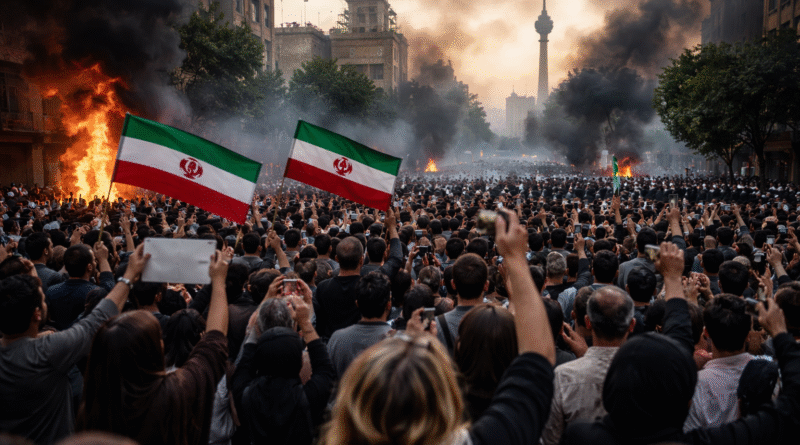
Iran on Fire: Understanding the Iran Protest 2026
The unrest that swept across Iran in late 2025 and carried into early 2026, now widely referred to as the Iran protest 2026, did not erupt overnight. It grew slowly, under pressure, and finally spilled onto the streets. Media coverage, however, often reduced it to extremes. One side framed it as brutal state repression. The other blamed foreign interference.
Reality sits somewhere deeper.
The roots of the crisis are economic stress, political fatigue, and social change that has been building for years. Iran’s position in West Asia makes this unrest far more than a domestic issue. It affects energy markets, regional security, and countries like India that are closely linked to the region. This broader setting is essential to understand the dynamics of the Iran protest 2026.
Economic Roots of the Protests
The immediate spark was money, or rather, the lack of it.
In December 2025, the Iranian rial collapsed to historic lows. On December 28, Tehran’s powerful merchant class, known as the Bazaaris, shut down markets in protest. Importing everyday goods had become nearly impossible.
On paper, the official exchange rate stood at 42,000 rials per US dollar. In reality, the market rate had fallen to nearly 1.45 million. This gap was not just symbolic. It crushed livelihoods. Compared to 1979, the rial had lost almost all its value.
In 2025 alone, the currency fell by 45 percent. Prices of essentials like rice and cooking oil soared. Profits disappeared. Savings evaporated.
What began as anger among traders quickly spread. Unemployed youth, low-income workers, and urban middle classes joined in. The protests stopped being about currency alone. They became about dignity and survival.
How the Iranian State Responded
Iran’s leadership has faced mass protests before. Over decades, it has developed a familiar method to contain them.
The first response is force. Police action intensifies. Information is tightly controlled.
Next comes mixed messaging. Officials warn of foreign conspiracies while offering limited concessions.
The third phase focuses on wearing people down. Internet access is restricted. Pro-government rallies are organised. Protest groups lose coordination.
The final stage comes later. Arrests follow. Trials are held. Punishment is made visible.
By early 2026, Iran appeared to be firmly in the third phase of this cycle during the Iran protest 2026. The government announced a monthly cash transfer of 10 million rials. In dollar terms, it was modest. Symbolism mattered more. Funerals of security personnel were televised. Rallies against foreign interference filled state media.
Most importantly, the system held. The Revolutionary Guards stayed loyal. The regular military did not fracture. Oil production continued. Protesters failed to produce a unified leadership.
Analysts note that the current wave of protests in Iran has grown broader and more layered than in previous episodes, with several observers viewing it as one of the most significant movements since 1979.
Cracks Beneath the Surface
The Bazaar and the Clergy Drift Apart
Historically, Iran’s merchants were political kingmakers. Their withdrawal of support helped bring down the Shah in 1979.
For decades, Bazaaris and clerics benefited from each other. Merchants gained access to imports and currency advantages. Clerics gained economic backing.
That relationship is weakening.
Sanctions, corruption, and the rise of businesses linked to the Revolutionary Guards have squeezed traditional traders. Many feel pushed aside. Whether the Guards are willing to share economic space to restore this alliance remains an open question.
A Growing Gap Between State and Society
Nearly two-thirds of Iranians were born after the revolution. Their worldview is shaped less by ideology and more by daily reality. They compare their lives not with the past, but with the Gulf states they see online.
Iranians see corruption among elites. They face limited job prospects. Women and minorities feel tightly constrained. The middle class feels stuck.
The election of a moderate leader in 2024 raised hope for change. That hope faded quickly. Regional crises and entrenched clerical power blocked meaningful reform.
External Pressure and National Response
Foreign leaders openly voiced support for Iranian protesters. Threats of punishment followed. Yet history shows that external pressure often strengthens the Iranian state internally.
Iran’s political culture prizes resistance. During Iraq’s invasion in 1980, external aggression unified society rather than divided it.
Despite military losses in mid-2025, Iran retains the ability to respond asymmetrically. Its reach across the Persian Gulf and the Strait of Hormuz remains a serious strategic factor.
Direct intervention carries risks few are willing to test.
Why This Matters for India
Stability in the Gulf
Any escalation in Iran threatens Gulf stability. For India, this means energy insecurity, risks to trade routes, and uncertainty for millions of Indian workers in the region.
Strategic Access
Iran is India’s gateway to Afghanistan and Central Asia through the Chabahar port. This route bypasses Pakistan and holds long-term strategic value.
Social and Cultural Links
India has the world’s second-largest Shia population. Events in Iran resonate deeply within these communities and influence wider regional dynamics.
Economic Potential
If sanctions ease in the future, rebuilding Iran will require infrastructure, healthcare, energy, and manufacturing support. India is well placed to participate, especially given Iran’s focus on domestic industry.
Conclusion
The unrest of 2025–26, culminating in the Iran protest 2026, is not an isolated outburst. It reflects deeper tensions inside a state strained by sanctions, demographic change, and economic pressure.
The Iranian system has shown resilience. Force, elite unity, and the absence of organised opposition have kept it afloat.
But unresolved problems do not disappear. They return.
For India and other external actors, the Iran protest 2026 shows how unrest inside Iran is tied to a wider diplomatic recalibration across West Asia and beyond, and why ignoring one leads to a flawed reading of the other.
The Analysis Desk at ThirdPol analyses political and economic developments in Iran and their wider impact on West Asian geopolitics and India’s foreign policy.
Pingback: USA and Iran Relations: A History of Conflict and Mistrust