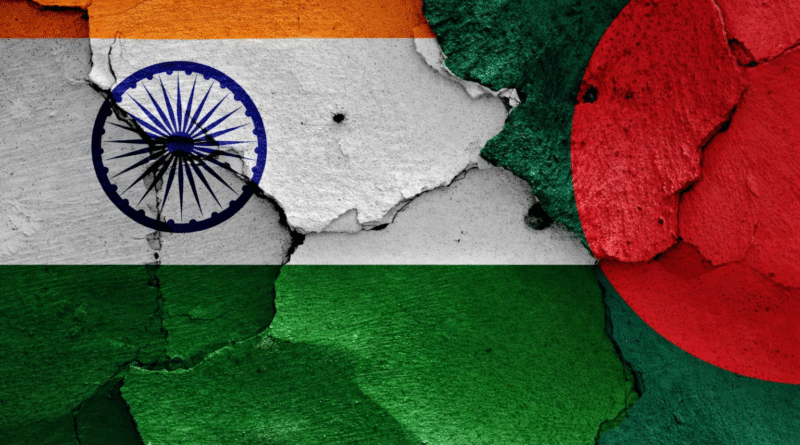
India–Bangladesh Relations: History, Cooperation and Challenges
India–Bangladesh relations share one of South Asia’s most layered bilateral relationships. It is shaped as much by memory and geography as by strategy and policy choices.
The relationship is rooted in the upheaval of the 1947 Partition, which divided communities and families across what later became an international boundary. These disruptions created enduring social and emotional links that still influence political perceptions on both sides.
India’s support during Bangladesh’s Liberation War in 1971 remains the defining moment in bilateral ties. India not only backed the independence movement but also became the first country to formally recognise Bangladesh. This history of shared sacrifice continues to act as a stabilising force, even during periods of political strain.
In recent years, New Delhi has described the relationship as being in a ‘Sonali Adhyay’, or golden phase, reflecting the steady expansion of cooperation across sectors.
Why Bangladesh Matters to India
Bangladesh occupies a critical place in India’s regional calculus.
Geographically, it surrounds much of India’s northeastern region and shares long land, riverine, and maritime boundaries. Stability and cooperation with Dhaka are therefore essential for border management, internal security, and regional connectivity.
Economically, bilateral trade has expanded steadily, crossing 18 billion US dollars in 2021–22. India is among Bangladesh’s largest trading partners, while Bangladesh has emerged as an important market for Indian exports.
Strategically, Bangladesh sits at the junction of South and Southeast Asia. Its role is central to India’s Act East Policy, which seeks deeper economic and political engagement with Southeast Asia.
Culturally, the two societies remain closely linked through language, literature, and shared historical experience. These people-to-people ties give the relationship a depth that is uncommon in the region.
Environmental interdependence further binds the two countries. Shared river systems and ecosystems such as the Sundarbans require sustained cooperation on water management, flood control, and climate resilience.
Key Areas of Cooperation
Economic cooperation has become the backbone of the relationship. Bangladesh is India’s largest trade partner in South Asia, and trade volumes have grown consistently over the past decade.
Connectivity has seen significant progress. Rail links severed after 1965 are being restored, including the reopening of the Haldibari–Chilahati railway line. Passenger services such as the Maitree Express and Bandhan Express have improved cross-border movement.
Inland waterways are being developed under the Protocol on Inland Water Transit and Trade, reducing transport costs and improving regional supply chains. The Agartala–Akhaura rail link is set to directly connect India’s northeast with Bangladesh.
Development cooperation is another pillar. Since 2010, India has extended lines of credit worth about 8 billion US dollars to support infrastructure projects in Bangladesh, covering roads, railways, ports, and energy.
India also invests in capacity building through training programmes and scholarships for Bangladeshi officials and professionals. Cultural exchange is promoted through institutions such as the Indira Gandhi Cultural Centre in Dhaka.
Defence and security cooperation has deepened through regular military exchanges, joint exercises, and coast guard coordination. Energy cooperation includes fuel supply agreements and collaboration on the Rooppur Nuclear Power Plant.
Persistent Challenges
Despite steady progress, several issues continue to test the India–Bangladesh relations.
Unresolved border demarcation in limited areas and concerns over illegal migration have domestic political implications in India’s border states.
Trade faces friction from non-tariff barriers, administrative delays, and infrastructure gaps that limit the full potential of economic integration.
Water sharing remains a sensitive issue. With 54 shared rivers, disputes such as the unresolved Teesta agreement and concerns over the Farakka Barrage continue to shape bilateral negotiations.
Security concerns have not entirely disappeared. Although cooperation against insurgent groups has improved, mutual confidence requires continuous engagement.
China’s expanding economic and strategic presence in Bangladesh adds another layer of complexity. Investments linked to infrastructure, ports, and energy have implications for regional balance and India’s long-term strategic interests.
The Road Ahead
For India–Bangladesh relations , the challenge is not managing a hostile relationship but sustaining momentum in a partnership that is already broad and functional.
Resolving the Teesta river issue would send a strong political signal and remove a long-standing irritant. Improving physical connectivity across land, water, and coastlines would deepen economic integration.
Energy cooperation, particularly in renewables and cross-border infrastructure, offers opportunities for shared resilience. Progress on a Comprehensive Economic Partnership Agreement could further anchor economic ties.
From India’s perspective, continued development support, technology sharing, and reliable delivery on commitments remain essential to maintaining trust, especially in the context of growing Chinese influence.
The durability of India–Bangladesh relations will ultimately depend on whether both sides can translate historical goodwill into consistent policy outcomes. For now, the relationship remains one of India’s most stable and strategically significant partnerships in South Asia.
The Analysis Desk at ThirdPol writes on India’s foreign policy, regional security, and shifts shaping South Asia.